From BOM to LCA: How Product Composition Becomes Environmental Data
Learn how a Bill of Materials becomes an LCA by mapping product materials and components to environmental datasets.
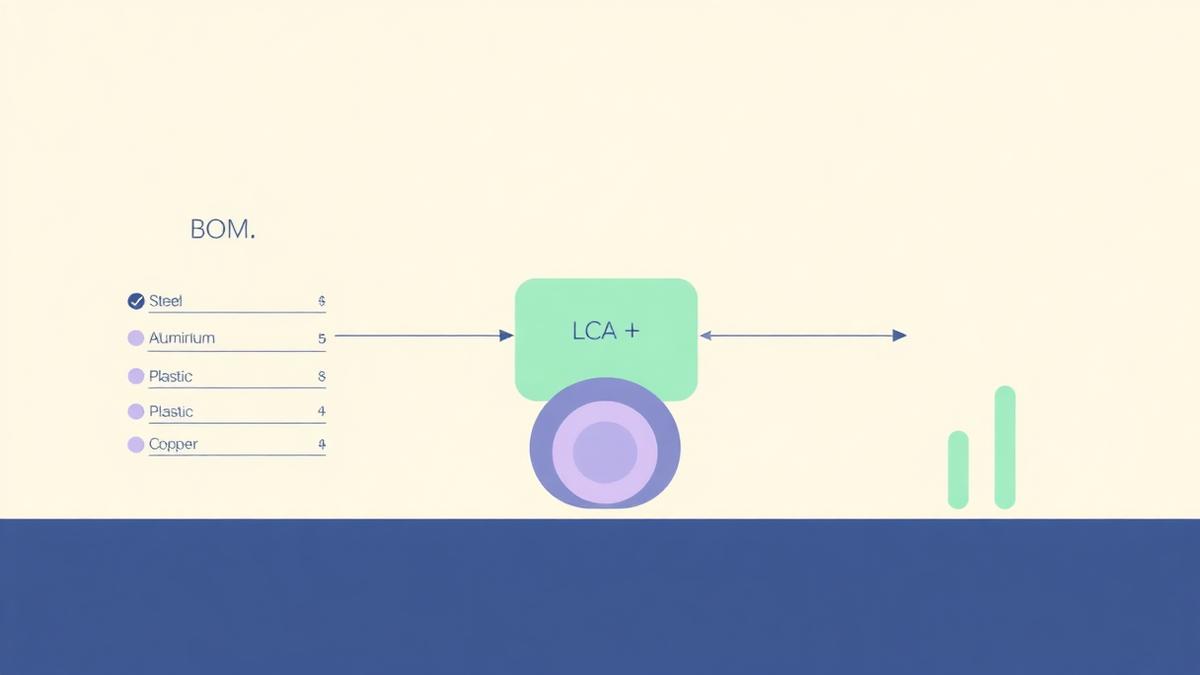
A Bill of Materials (BOM) tells you what a product contains. A Life Cycle Assessment (LCA) helps quantify the environmental impacts associated with that product system. Connecting the two is one of the most important steps in product-level environmental analysis.
This article explains how product composition becomes environmental data, why dataset selection matters, and how keeping BOM and LCA connected helps teams make better product decisions. See how EasyLCA automates BOM-to-LCA mapping or book a demo to see the workflow in action.
What is a BOM?
A Bill of Materials describes the components and materials required to manufacture a product.
For example:
- Steel: 20 kg
- Aluminium: 5 kg
- ABS plastic: 3 kg
- Copper: 2 kg
This describes physical composition, but not environmental impact.
How does a BOM become LCA data?
Each material can be connected to an appropriate environmental dataset.
Conceptually: Material quantity × environmental dataset = environmental contribution.
If a product contains 5 kg of aluminium, an appropriate aluminium dataset can be used to estimate the environmental impacts associated with that material according to the study's methodology and system boundaries.
The calculation is then repeated across the product system.
Why is dataset selection important?
Two datasets describing the same material can produce different results.
Differences can include:
- geography
- production technology
- recycled content
- energy mix
- system boundaries
- data year
Dataset selection therefore needs to reflect the product being assessed as closely as reasonably possible.
What information improves BOM matching?
Useful fields include:
- material name
- material specification
- quantity
- unit
- geography
- supplier
- recycled content
- manufacturing process
Instead of recording only steel, record information such as: Stainless steel, 304, 12 kg, EU, Supplier A — where reliable information is available.
What about manufacturing?
Materials are only part of an LCA. Depending on the goal and scope, additional information can include:
- manufacturing processes
- electricity
- heat
- transport
- packaging
- waste
- product use
- maintenance
- end-of-life treatment
What if supplier-specific data is unavailable?
Secondary environmental datasets can be used where appropriate.
As better primary data becomes available, generic datasets can potentially be replaced with more representative information.
This makes LCA an iterative process rather than a one-time spreadsheet exercise.
Why should BOM and LCA stay connected?
Imagine a product changes from 5 kg aluminium to 4 kg aluminium. If product composition and LCA are connected, the environmental model can be updated systematically.
This makes it easier to compare product versions and evaluate design changes.
The key takeaway
The connection between BOM → dataset → environmental impact turns ordinary product information into actionable sustainability data.
Once that connection exists, companies can use environmental information earlier in product development instead of calculating impacts only after a product is finished. Learn the basics of LCA or prepare your data for DPP.
Frequently Asked Questions About Life Cycle Assessments
Ready to run your first LCA?
See how EasyLCA turns a Bill of Materials into an ISO-aligned Life Cycle Assessment in minutes.